
 Deutsch
 Ελληνικά
The History of AHEPA
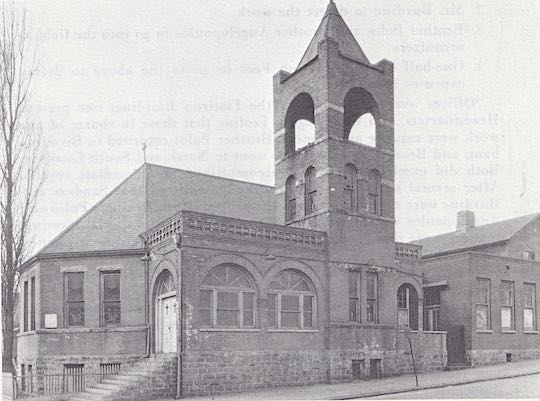
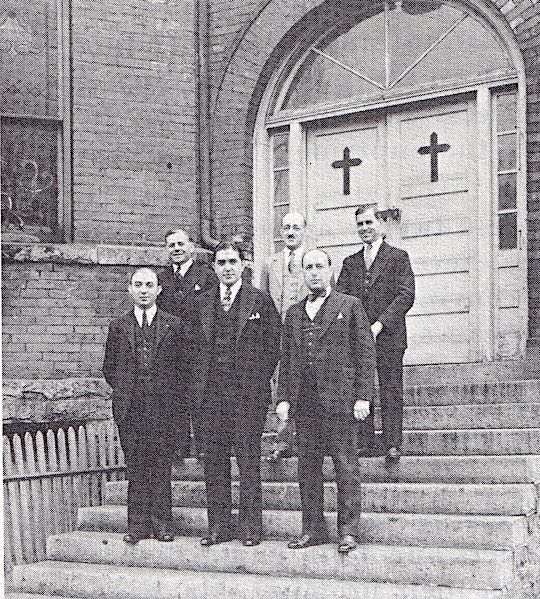
The Founding — July 26, 1922, Atlanta, Georgia
It was a hot July day in 1922 when six Greek immigrants gathered in the hall of the Greek Orthodox Church in Atlanta, Georgia — laying the foundation for one of the most significant Greek-American organizations of all time. Two more joined shortly after. Eight men, all residents of Atlanta, all immigrants from Greece, founded the American Hellenic Educational Progressive Association — AHEPA — at 3:00 p.m.
It was no coincidence that Atlanta was chosen as the founding location: the city was at that time the national headquarters of the Ku Klux Klan. The founders’ response to the wave of hatred was not violence, but organization. GreekReporter.com
Discrimination against Greek immigrants was violent and widespread. KKK members threatened and attacked customers of Greek restaurants and confectionery shops. The result: daily revenues collapsed from $500–$1,000 to barely $25. Many business owners were forced to sell their shops at rock-bottom prices to non-Greeks. In northern states like Indiana, also controlled by the KKK, crosses were burned in front of Greek family homes. Orthodox Christians were forced to indefinitely postpone the founding of communities. Greek names were Americanized — out of fear of reprisals. Wikipedia
With a starting capital of just $80, the eight founders dared to attempt to organize the city of Atlanta. Their goal: to promote citizenship, teach the English language, convey democratic values — while at the same time preserving Hellenic pride. Ahepa
Just five days after the founding, the Supreme Lodge decided not to restrict membership to Greeks, but to keep it open to all. Ahepa
From the very beginning, AHEPA cooperated with B’nai B’rith and the NAACP in the common fight against discrimination and intolerance. In the first year, 32 Chapters were founded in 14 states and 1,300 members were admitted — despite adverse circumstances and constant financial difficulties. Ahepa
As the first Supreme President Nicholas D. Chotas said at the first National Convention in 1923: „Barely a year has passed since we tried to organize the city of Atlanta with eighty dollars in hand — and today representatives from across the country are seated here.” Ahepa
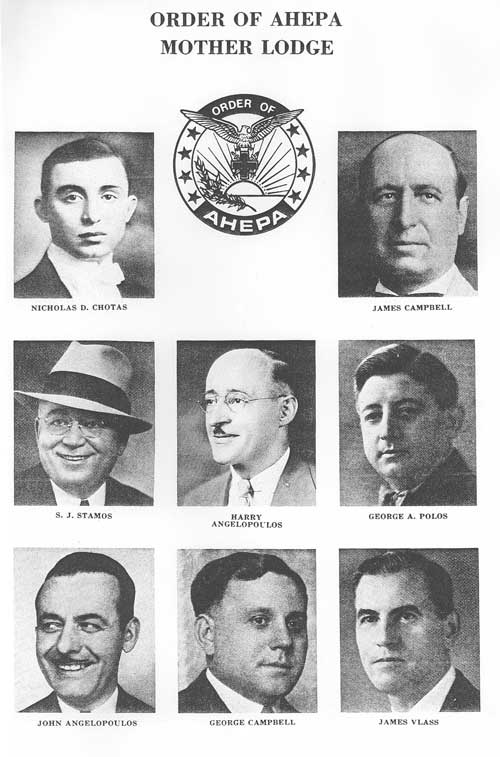
The Founding Fathers of AHEPA — the “Mother Lodge”
The first six founders were Nicholas D. Chotas from Lechaina, James Campbell from Kakotary, George A. Polos from Karpenisi, Harry Angelopoulos from Divry, John Angelopoulos from Divry, and James Vlass from the island of Ithaca. George Campbell and Speros J. Stamos joined shortly after, completing the Mother Lodge with eight members.
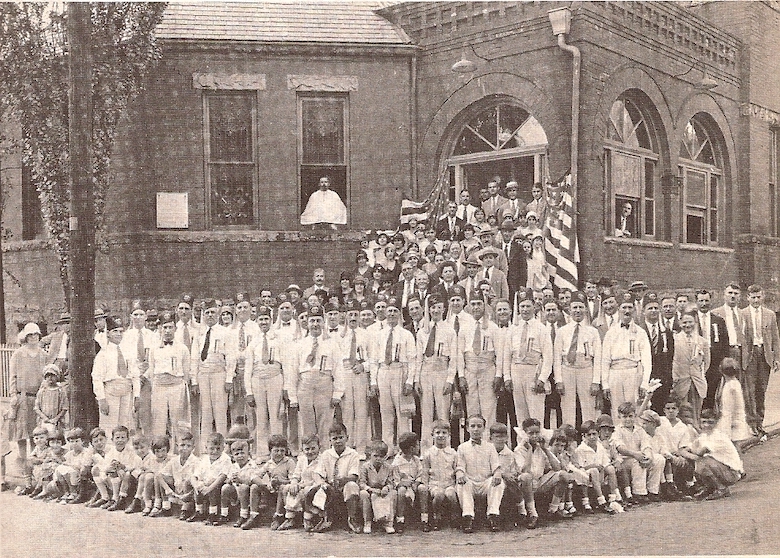
The AHEPA Family (1926–1930)
The AHEPA Family is born — 1926 to 1930
In just four years, AHEPA grew from a single organization into a complete family of four sister organizations — a testament to how deeply it had already taken root in the Greek-American community.
Sons of Pericles — February 3, 1926, Manchester, New Hampshire. Eleven young Greek-American men founded the Sons of Pericles together with members of the AHEPA Chapter in Manchester. Their founder, Dr. Alexander Cambadhis, gave the organization a clear goal: to pass Hellenism on to the next generation and keep the connection to Greek culture alive for generations to come. The first Chapter named itself Queen City Chapter No. 1. Just one year after its founding, the first National Convention was held in Lowell, Massachusetts — with 14 Chapters. In 1928, the Sons of Pericles were officially recognized as the Junior Order of AHEPA in Detroit. HACCM
Daughters of Penelope — November 16, 1929, San Francisco, California. Alexandra Apostolides Sonenfeld fulfilled her life’s dream and founded the very first Greek-American women’s organization in the United States — EOS Chapter No. 1 with 25 charter members. In 1931 she was elected the first Grand President. One of the organization’s most significant achievements: Penelope House in Mobile, Alabama — the first shelter for victims of domestic violence in the entire state of Alabama. HACCM LOC
Maids of Athena — July 5, 1930, Tacoma, Washington. Founded as a youth organization for young women between the ages of 14 and 28, the Maids of Athena completed the AHEPA Family. The first constitution and ritual were put into writing in 1935. Wikipedia
The AHEPA Family thus consisted of four organizations — a model that endures to this day:


AHEPA and the White House
1924 — Just two years after its founding, AHEPA representatives visited President Calvin Coolidge at the White House. The beginning of a unique relationship. GreekReporter.com
1931 — Roosevelt. On March 11, 1931, Franklin D. Roosevelt, then Governor of New York, was inducted into AHEPA at his office in Albany. When invited to join, he responded in typical Roosevelt fashion: „If Charles Peabody can become as good a Greek as that, I can too.” He remained an active, dues-paying member of Delphi Chapter No. 25 until his death — for 14 years. Ahepa
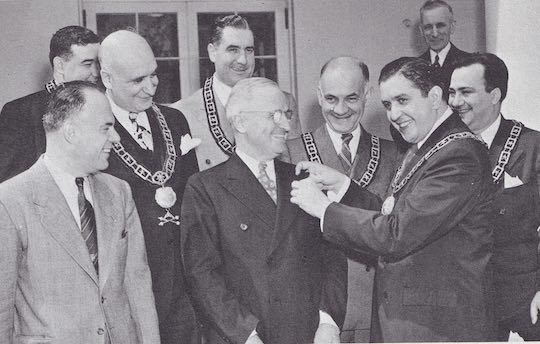
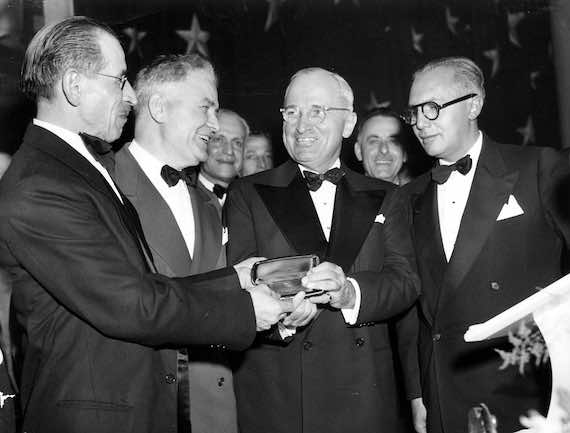
March 25, 1946 — Truman. The AHEPA Supreme Lodge visited President Harry S. Truman at the White House and officially inducted him into the Order of AHEPA. Truman enacted the Truman Doctrine in 1947, saving Greece from communist takeover — an act for which Greece dedicated a monument to him in Athens, making him the only U.S. President to be honored with a statue in Greece. Ahepahistory
Gerald R. Ford was also a member of AHEPA — making a total of three U.S. Presidents brothers of the organization. The National Herald
The tradition is maintained to this day: Every year, AHEPA representatives attend the Greek Independence Day Celebration at the White House. Stjohnthedivine
„The heroic struggle of the Greek people to defend their liberties and their homes against the aggression of Germany after they had so signally defeated the Italian attempt at invasion has stirred the hearts and aroused the sympathy of the whole American people.”
President Franklin D. Roosevelt, member of AHEPA, to the AHEPA Supreme Lodge, April 25, 1941
World War II
On October 28, 1940, the Italian Ambassador presented Greek Prime Minister Metaxas with an ultimatum at 3 o’clock in the morning, demanding that Italian troops be allowed to occupy strategic points in Greece. Metaxas had three hours to respond. His immediate reaction was a single word: OXI! — No! Ahepahistory
Although Greece held its ground against the numerically far superior Italian forces and even pushed them back, Hitler’s intervention forced the country to surrender after 21 days — having already fought Italy for five months. This delay of the German attack on Russia would prove fatal to Hitler’s plans. Ahepahistory
The Greek War Relief Association
Even before the war reached Greece, Greek-American organizations under the leadership of Spyros P. Skouras founded the Greek War Relief Association. Names like Rockefeller, Morgan, Astor and Goldman stood alongside thousands of ordinary citizens. More than $300,000 was raised by December 1940 alone. Ahepahistory
Skouras said of AHEPA’s role: „In shaping this Association into a coherent and effective agency for bringing relief to Greece, the Order of AHEPA has played a very important role. They rose to meet it magnificently.” Ahepahistory
The War Bonds — $50 Million and more
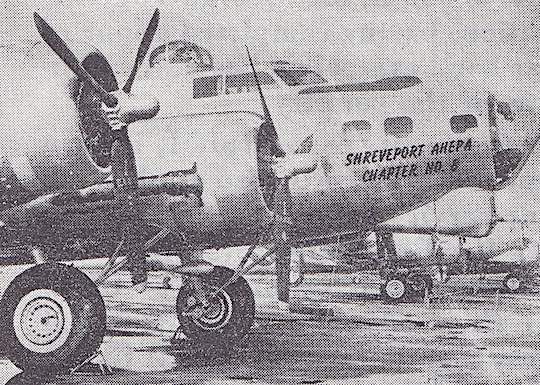
On October 28, 1942, the second anniversary of the Greek OXI, AHEPA launched a national war bond campaign on NBC Radio — with speaker Sam Rayburn, Speaker of the House of Representatives, as well as Gary Cooper and Greek actress Katina Paxinou. The goal: $50 million in four months. Ahepahistory
The result exceeded all expectations. The U.S. Treasury Department appointed AHEPA as the only civic organization to serve as an official issuing agent for war bonds. By the end of July 1944, AHEPA members had sold war bonds worth over $162 million. Ahepahistory
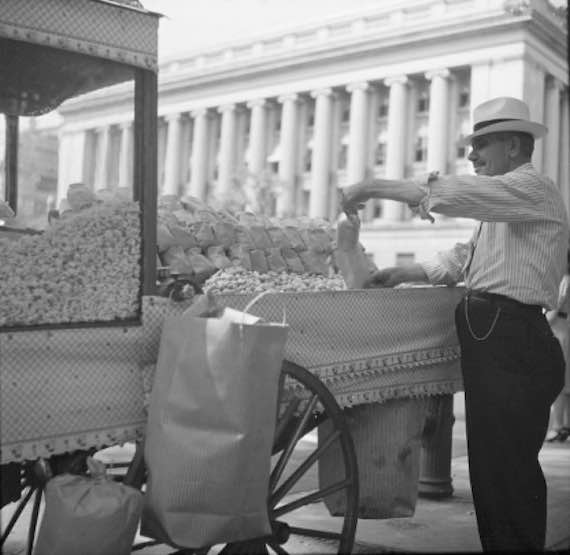
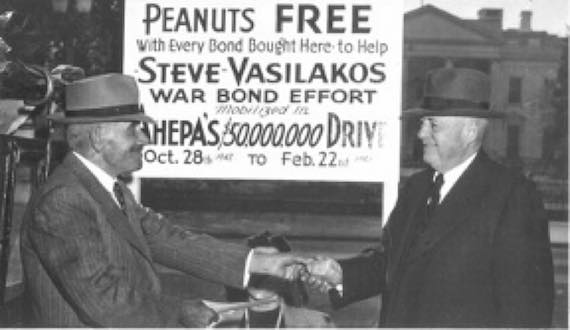
The story of Steve Vasilakos — the Greek peanut vendor in front of the White House — stands as a symbol of this era: his sign read: „Peanuts free with every war bond purchased here.” His very first customer was none other than Sam Rayburn, Speaker of the House of Representatives, himself. Ahepahistory

The Truman Doctrine — AHEPA saves Greece
On March 25, 1946, the AHEPA Supreme Lodge visited President Harry S. Truman at the White House and officially inducted him into the Order of AHEPA. Also present was Michael Loris — the AHEPA brother from Brooklyn named national champion war bond salesman by the U.S. Treasury Department. EH.net
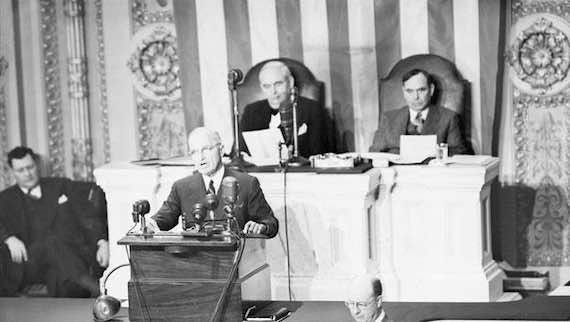
Less than a year later, on March 12, 1947, President Truman appeared before a joint session of Congress and delivered one of the most important speeches of the Cold War. Great Britain had announced that it would discontinue its military and economic support for Greece — in the middle of the Greek Civil War against communist forces. EH.net
Truman’s words to Congress: „The United States has received from the Greek government an urgent appeal for financial and economic assistance. Greece must have this assistance in order to become a self-supporting and self-respecting democracy.” EH.net
The Truman Doctrine provided $2 billion in aid for Greece and Turkey — and saved Greece from communist takeover. Ahepa-12
The Truman Statue — a unique act of gratitude
As a sign of gratitude, AHEPA decided to erect a monument to President Truman — in Athens, directly next to the U.S. Embassy. On May 29, 1963, the 12-foot bronze statue was unveiled before 20,000 people. In his message, President John F. Kennedy wrote: „I hope this outstanding memorial, which the Order of AHEPA has made possible, will come to symbolize not only our common heritage and efforts, but will serve to remind us of the high priority President Truman gave to freedom.” Stjohnthedivine
The inscription on the base reads: „Harry S. Truman — Statesman, Humanitarian, Philhellene. Dedicated by the Order of AHEPA, May 29, 1963 — in grateful acknowledgement of the Truman Doctrine which he as President of the United States proclaimed on March 12, 1947, thereby helping the Greek people to preserve their freedom and national integrity at a crucial turn in the history of mankind.” EH.net
The statue has since been bombed four times, attacked with a chainsaw, and toppled at least five times. When a bomb destroyed it in 1986, the Mayor of Athens suggested replacing it with a statue of Abraham Lincoln. AHEPA insisted on rebuilding Truman — and did. Stjohnthedivine
The AHEPA Hospital
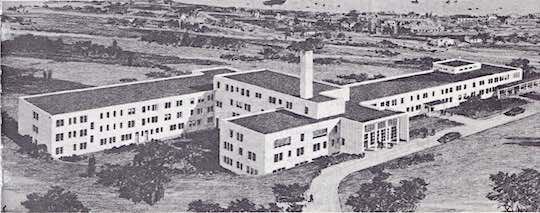
Even during World War II, AHEPA decided at its 1945 National Conference to build a hospital in Greece. The war-ravaged country was in urgent need of medical infrastructure — nearly 400,000 homes had been destroyed and 1.5 million people were suffering from malaria. EH.net
The AHEPA University General Hospital in Thessaloniki was founded in 1947 with the financial support of AHEPA. It opened to the public in 1951 during the celebrations of the 25th anniversary of Aristotle University of Thessaloniki and began regular operations in March 1953. Academia.edu
Today it is one of the largest hospitals in Greece with 680 beds, a complete spectrum of medical and surgical specialties — from cardiology and neurosurgery to oncology and nephrology. It is also a leading teaching and research hospital of Aristotle University. Ahepa528
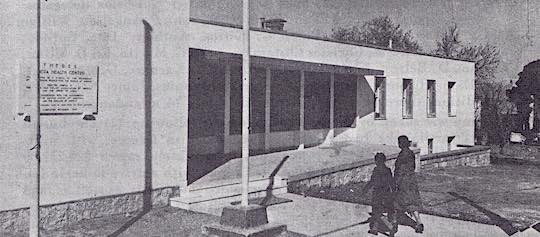
In 1948, the first AHEPA health center in Greece opened in Chrysoupolis, Kavala — the first of several medical facilities in the country. Ahepa528